Let’s be honest. For years, buying a laptop felt like a compromise. You either paid a premium for an Apple MacBook, or you dove into the vast, often confusing world of Windows laptops and Google Chromebooks, hoping to find a hidden gem. The MacBook was the “luxury car” sleek, powerful, but not for every budget. That era is officially over.
Apple has masterfully reshuffled its deck. It has quietly built a MacBook lineup that caters to nearly every type of user and budget, all without sacrificing the quality and experience people expect. This isn’t just about selling more laptops; it’s a direct challenge to the market dominance of Google and Microsoft. And if I were them, I’d be a little worried.
The New Battlefield: A Mac for Every Mission
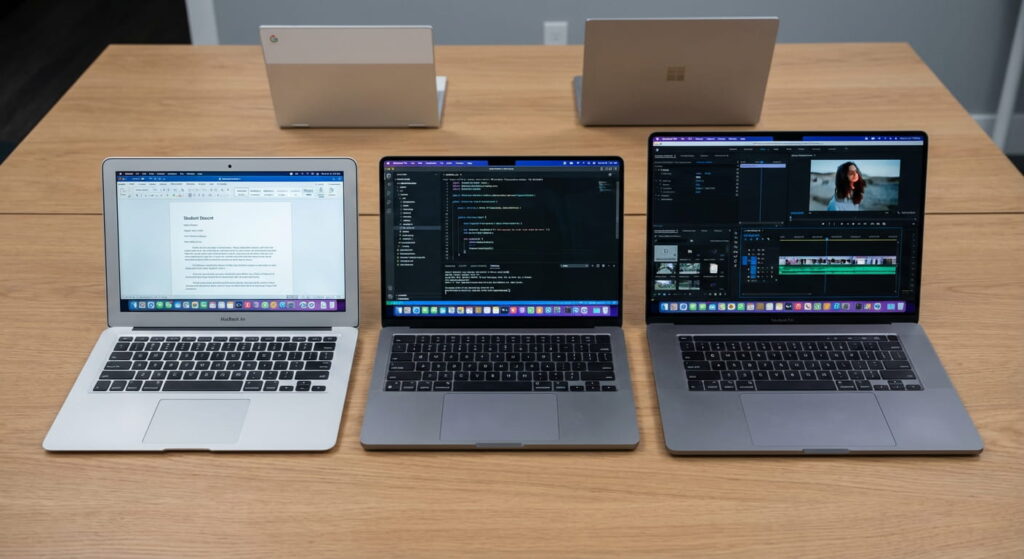
Apple’s genius lies in its simplicity. They’ve created a clear, three-tiered system where every user can find their perfect match. Think of it less as a product list and more as a “Who is this for?” guide.
Here’s a quick breakdown of how Apple is targeting different users:
| The MacBook | Perfect For… | Why It Wins |
|---|---|---|
| MacBook Air | Students, teachers, office workers, and anyone who needs a reliable daily driver. | The ultimate blend of price, portability, and all-day power. It just works. |
| 14-inch MacBook Pro | The “Prosumer”—developers, photographers, and serious content creators. | A powerhouse that’s still portable enough to take anywhere. It’s the new sweet spot. |
| 16-inch MacBook Pro | The hardcore professional—video editors, 3D artists, and music producers. | Unrivaled, desktop-grade performance for the most demanding tasks. |
This clear strategy eliminates the confusion that plagues the Windows laptop market. You don’t need to compare dozens of models with cryptic names and numbers. You just need to ask yourself: “What do I do?”
The MacBook Air: Winning Over the Masses
The MacBook Air is Apple’s Trojan horse. Powered by their game-changing M-series chips, it’s no longer the “lesser” MacBook. It’s a powerhouse in its own right and a direct threat to the bread and butter of Google and Microsoft.
For years, schools and businesses bought Chromebooks because they were cheap and simple. But now, for a little more, the MacBook Air offers a monumental leap in user experience. You get a stunning screen, a best-in-class keyboard and trackpad, and performance that runs circles around most Chromebooks.
The same goes for mid-range Windows laptops. In the past, you had to accept trade-offs: a slow processor, a dim screen, or a cheap plastic build. The MacBook Air delivers a premium, consistent experience, making it a surprisingly easy choice for the average person who just wants a great laptop without the headache.
The MacBook Pro: A Pincer Move on the High-End Market
While the Air conquers the mainstream, the MacBook Pro models are executing a classic pincer movement on the high-end market once dominated by Microsoft’s Surface and premium Windows devices from Dell and HP.
The 14-inch MacBook Pro is for the person who needs more. More power for coding, more graphical muscle for photo editing, and a display that is simply one of the best ever put on a laptop. It hits a perfect balance of power and portability that competitors are struggling to match.
The 16-inch MacBook Pro is the final boss. It’s an unapologetic beast of a machine built for professionals who need zero compromises. Its raw power and incredible efficiency have made it the new gold standard in the creative industry, leaving many Windows-based workstations in the dust.
The Unfair Advantage: Apple’s M-Series Silicon
So, how did Apple pull this off? The answer lies in one thing: their own chips.
By designing the M-series processors in-house, Apple unlocked a level of performance and battery life that competitors relying on off-the-shelf chips from Intel or AMD simply can’t replicate. This is called vertical integration, and it gives Apple three huge advantages:
- Peak Efficiency: The hardware and macOS software are built for each other, resulting in a buttery-smooth experience and insane battery life.
- Raw Power: Apple optimized these chips for the tasks people actually do on a Mac, from video editing to everyday browsing.
- Cost Control: Making their own chips gives Apple more control over pricing, allowing them to offer the base MacBook Air at a highly competitive price point.
This tight integration of hardware and software is a fortress that Google and Microsoft have yet to breach. For a deeper look at just how significant this shift is, this article from The Verge provides an excellent external reference on the real-world impact of these chips.
Where Does This Leave Google and Microsoft?
The pressure is on.
- Google’s Chromebooks are being squeezed into the budget corner. Their main selling point was price, but as the MacBook Air becomes more accessible, “cheap” is no longer enough.
- Microsoft’s Surface devices, while innovative, are caught in the middle. The MacBook Air is a better traditional laptop, and the iPad is a better tablet, leaving the Surface in a tough spot.
To compete, they can’t just release another laptop. They need to create an experience that is genuinely better or more compelling. They need to answer a simple question: “Why should someone buy this over a MacBook?”
Right now, Apple has a very strong answer for every type of customer. And that’s a powerful position to be in.